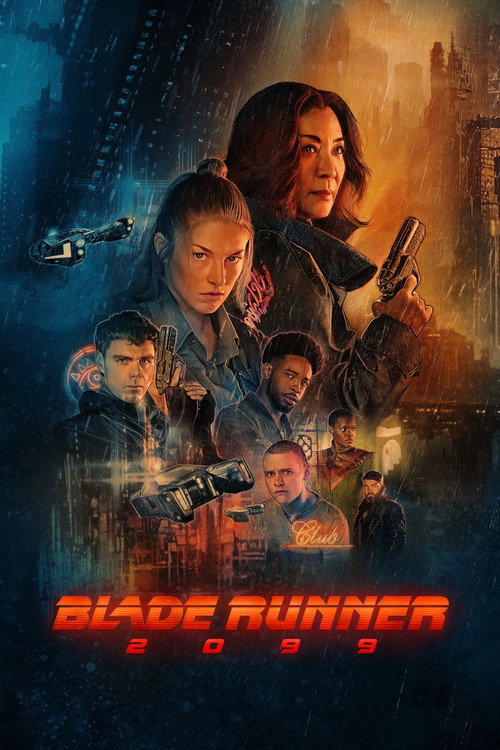
Blade Runner 2099 Season 1 Review: Beautiful to Look At, Harder to Connect With
Blade Runner 2099 looks incredible and features excellent performances, but slow pacing and an uneven story keep Season 1 from reaching the emotional and philosophical heights of the films.
There might not be another science-fiction franchise where atmosphere matters as much as it does in Blade Runner.
The rain. The neon. The massive cityscapes. The oppressive corporations. The uneasy relationship between humans and artificial life. But underneath all of that has always been something much more important: deeply human stories about identity, memory, mortality, and what actually makes someone human.
Blade Runner 2099 absolutely understands the first part.
I'm not convinced it completely delivers on the second.
At 6.7/10, Season 1 is a visually spectacular and frequently fascinating return to the Blade Runner universe. Hunter Schafer and Michelle Yeoh are excellent, the world-building is impressive, and its exploration of artificial intelligence feels particularly relevant right now.
The problem is that the storytelling never consistently matches everything happening around it.
This Absolutely Looks Like Blade Runner
Let's start with the biggest positive.
This show looks incredible.
The futuristic Los Angeles setting immediately feels like it belongs in the same universe as Blade Runner and Blade Runner 2049. Towering architecture disappears into darkness. Neon cuts through the city. Technology is everywhere without making life seem particularly better.
Most importantly, the world feels lived in.
That's something both movies did exceptionally well. You never felt like you were looking at a science-fiction set. You felt like these were actual cities that had existed for decades before the camera arrived.
2099 captures some of that same feeling.
The production design, cinematography, lighting, and visual effects are easily among the strongest aspects of Season 1. Even during episodes where the story starts dragging, there's usually something visually interesting enough to keep you engaged.
If the goal was simply to prove that the Blade Runner aesthetic could survive the transition from film to television, consider that mission accomplished.
Hunter Schafer and Michelle Yeoh Are Excellent
Fortunately, the series also has two performances capable of competing with all that visual spectacle.
Hunter Schafer and Michelle Yeoh are excellent.
Both bring emotional complexity to characters who could have easily become little more than vehicles for the show's larger philosophical questions.
Their relationship becomes one of the strongest parts of the season because it gives the series something personal underneath all the technology, mystery, and world-building.
Yeoh brings exactly the kind of presence you'd expect. There's weight behind even relatively quiet moments.
Schafer is equally compelling and proves more than capable of carrying large portions of the story.
When Blade Runner 2099 slows everything down and allows these characters to simply exist together, the show is often at its best.
That's also where you begin seeing glimpses of the emotional depth that made the movies so memorable.
Unfortunately, the series doesn't stay there often enough.
The AI Story Couldn't Be More Relevant
There's something fascinating about watching Blade Runner in 2026.
When Ridley Scott's original movie arrived, artificial intelligence and synthetic humans belonged almost entirely to science fiction.
That's obviously no longer the case.
We're now having real conversations about increasingly capable AI systems, artificial personalities, generated memories, human relationships with machines, and whether intelligence itself is enough to create something resembling consciousness.
Suddenly, questions Blade Runner has been asking for decades don't feel nearly as hypothetical.
What happens when artificial intelligence understands us?
What happens when it begins imitating us?
And eventually, what happens when the distinction between imitation and genuine experience becomes impossible to identify?
Those ideas give 2099 an enormous opportunity.
Some of the season's best moments explore exactly that territory.
But that's also where one of my biggest frustrations with the series begins.
We've Been Here Before
The original Blade Runner asked whether Deckard's targets were actually less human than the people hunting them.
Blade Runner 2049 took those ideas even further through memory, identity, love, reproduction, and the possibility that an artificial person could develop something resembling a soul.
Those are enormous ideas.
2099 returns to many of them.
The problem is that it doesn't always find enough new things to say.
There are moments where the series seems to be exploring familiar philosophical territory simply because that's what a Blade Runner story is supposed to do.
The questions are still interesting.
But we've heard some of them before.
And sometimes we've heard better answers.
That's particularly disappointing because our relationship with artificial intelligence has changed so dramatically since Blade Runner 2049. This should have been the perfect opportunity to push the franchise into genuinely new philosophical territory.
There are glimpses of that.
I just wanted more.
The Mystery Takes Too Long to Get Going
This is where Season 1 struggles the most.
The central mystery is interesting.
Getting there isn't always.
The story takes too long to develop, and several episodes feel stretched beyond what the material really requires.
Slow storytelling isn't inherently a problem for Blade Runner. Both movies are deliberately paced.
But there's a difference between slow and atmospheric and slow because the story isn't moving.
Season 1 occasionally crosses that line.
There are stretches where the beautiful production design almost becomes a distraction from how little narrative progress is actually being made.
Some supporting characters suffer from the same problem.
There are potentially interesting stories around the edges of the main narrative, but several never receive enough development to make their eventual importance feel earned.
That's where the television format should have been an advantage.
Eight hours gives you considerably more room than a movie.
Use it.
Instead, there are times when 2099 somehow feels both stretched out and underdeveloped.
That's the Frustrating Part
There is a really good show inside Blade Runner 2099.
You can see it constantly.
It's there in the performances.
It's there in the production design.
It's there when the series dives into questions about consciousness.
It's there when Yeoh and Schafer are given enough space to make the story personal.
Then the plot slows down again.
That's what keeps this from becoming something special.
The ingredients are all here. The series simply doesn't combine them into a story as powerful as the world surrounding it.
Comparing It to the Movies Isn't Entirely Fair, But It's Impossible Not To
This might ultimately be Blade Runner 2099's biggest problem.
It's called Blade Runner.
You can't separate it from what came before.
The original is one of the most influential science-fiction movies ever made. Blade Runner 2049 somehow managed to revisit that world decades later without simply copying it.
That's an incredibly high standard.
2099 doesn't reach it.
But maybe it doesn't need to.
As an expansion of the universe, there's plenty here worth watching.
As another Blade Runner story, it's solid.
As the next evolution of Blade Runner, it leaves me wanting something more ambitious.
Final Take
Blade Runner 2099 Season 1 is ultimately more impressive as a world than it is as a story.
Visually, it's fantastic.
Hunter Schafer and Michelle Yeoh are excellent.
The questions surrounding artificial intelligence, consciousness, identity, and humanity couldn't be more relevant.
But the central mystery develops too slowly, some episodes drag, supporting characters don't receive enough attention, and too much of the philosophical material feels like territory the movies already explored more effectively.
That doesn't make it a bad show.
Far from it.
For longtime Blade Runner fans, there's enough here to make Season 1 absolutely worth watching. And for anyone who loves intelligent, atmospheric science fiction, there are moments where this is exactly what you're looking for.
I just wish the story were as compelling as the world it takes place in.
6.5/10. A very solid choice, particularly for Blade Runner fans.