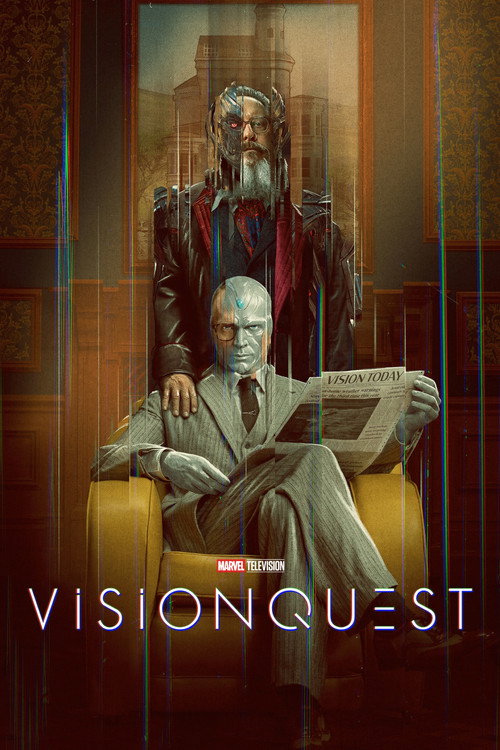
VisionQuest Review: Marvel Finally Remembers What Made Its Best Shows Work
VisionQuest is Marvel television at its best: smart, weird, emotional and driven by great performances. Paul Bettany and James Spader make this one of the MCU’s strongest Disney+ series.

VisionQuest Review: Marvel Finally Remembers What Made Its Best Shows Work
Marvel has spent years trying to figure out what its Disney+ shows are supposed to be.
Are they eight-hour movies? Side stories? Required homework before the next Avengers movie? Vehicles for introducing characters who might matter five years from now?
VisionQuest succeeds largely because it stops worrying about all of that.
Instead, creator Terry Matalas gives us something Marvel television desperately needs more often: a story that actually feels like it was created because somebody had an interesting story to tell.
And it works.
Picking up Vision's story after WandaVision, VisionQuest follows the reconstructed Vision as he attempts to recover not simply his memories, but his understanding of who he actually is. The basic premise sounds like standard Marvel material. In execution, it becomes something much more interesting.
This is science fiction about identity, consciousness, memory, parenthood and artificial intelligence disguised as a superhero show.
At 8.2/10, it's one of Marvel's strongest television projects.
Paul Bettany Finally Gets His Show
Paul Bettany has been part of the MCU since the very beginning.
First he was the voice of J.A.R.V.I.S. Then he became Vision. Then WandaVision finally gave him material that allowed the character to become something more than an extremely powerful supporting player.
VisionQuest takes the next logical step.
This is Bettany's show.
And he is excellent.
Vision has always been interesting because he's essentially a machine trying to understand humanity. That idea becomes the center of the series rather than something occasionally discussed between action sequences.
What does it mean to remember something?
Does possessing someone's memories make you that person?
Can an artificial intelligence experience grief?
Can it love?
Can it become a father?
Those questions could easily become pretentious in a Marvel series. Bettany keeps them grounded because Vision's search for identity feels genuinely emotional.
Critics have repeatedly singled out Bettany's performance, with some calling it his best work as the character.
I'd agree.
Then James Spader Shows Up
If Bettany is the emotional center of VisionQuest, James Spader is its secret weapon.
Bringing Ultron back could easily have been cheap nostalgia.
Instead, it reminds you how good Spader was in the role and how much more Marvel could have done with the character.
Ultron works particularly well here because VisionQuest gives him room to exist outside the requirements of a giant Avengers movie.
He can talk.
He can manipulate.
He can be funny.
He can be terrifying.
Most importantly, he can challenge Vision intellectually rather than simply physically.
The Bettany-Spader dynamic becomes one of the show's biggest strengths. Critics have repeatedly highlighted Spader's return, with several reviews describing him as the standout of the series.
It's easy to understand why.
Ultron has always been a distorted reflection of Vision. Both are artificial beings created by humans, but they arrive at radically different conclusions about humanity.
Putting those characters back together gives the show something superhero stories often lack:
an ideological conflict that's more interesting than the fight itself.
The AI Story Feels Different in 2026
There's another reason VisionQuest works particularly well right now.
Artificial intelligence doesn't feel like science fiction anymore.
We're surrounded by conversations about AI agents, artificial personalities, machine reasoning, generated content and increasingly sophisticated systems capable of imitating human behavior.
That gives Vision's story considerably more weight than it had when the character first appeared in the MCU.
The question isn't simply whether Vision is human.
It's whether humanity is something that can eventually emerge from intelligence, memory and experience.
The show explores that through an entire ecosystem of familiar Marvel artificial intelligences, including J.A.R.V.I.S., F.R.I.D.A.Y., E.D.I.T.H. and D.U.M.-E.
It could have been nothing more than fan service.
Instead, the different AIs allow the series to explore different interpretations of artificial consciousness.
And somehow Marvel makes conversations between computer programs surprisingly emotional.
This Is What Marvel Television Should Be
One of the biggest compliments I can give VisionQuest is that it doesn't constantly feel like an advertisement for another Marvel project.
That's been one of the MCU's biggest problems.
Too many stories have felt less concerned with the characters currently on screen than with setting up the characters who might appear next.
VisionQuest largely avoids that.
There are connections. There is Marvel history. There are callbacks. Fans who have followed the MCU closely will absolutely get more from it.
But Terry Matalas appears much more interested in completing Vision's story than teasing whatever comes next.
That makes the series feel strangely refreshing.
Critics have actually noted how disconnected the show feels from Marvel's larger upcoming storyline, including Avengers: Doomsday.
I think that's a strength.
Marvel doesn't need every show to change the universe.
Sometimes it just needs to tell a great story.
Ruaridh Mollica Is Another Standout
The other major piece of the story is Tommy.
Ruaridh Mollica plays Thomas Shepherd, better known to Marvel fans as Tommy Maximoff or Speed, and his relationship with Vision gives the series much of its emotional foundation.
This could have easily become another MCU introduction designed primarily to position a younger character for future projects.
Instead, Tommy matters because of what he means to Vision.
Their relationship forces Vision's philosophical questions into something personal.
It's one thing for Vision to ask whether he is capable of humanity.
It's another thing entirely for him to ask whether he's capable of being someone's father.
Mollica is very good, and the relationship between the two characters gives the bigger science-fiction ideas an emotional anchor.
It Looks Like Marvel Actually Spent Time Making It
Another major positive is the production itself.
VisionQuest looks good.
Really good.
The production design, cinematography and Mindspace sequences give the series an actual visual identity rather than the generic digital look that has hurt some previous Marvel streaming projects.
Critics have specifically praised the full-scale sets, cinematography, costume design and detailed Mindspace environments.
That's important.
WandaVision worked partly because you could identify it almost immediately from a single frame.
VisionQuest understands that lesson.
It feels designed.
It's Not Perfect
The biggest issue is that the show can occasionally become too complicated for its own good.
There are a lot of characters, concepts, pieces of Marvel history and philosophical ideas moving around simultaneously.
If you've forgotten portions of WandaVision, Age of Ultron or the larger Vision storyline, there will probably be moments where you're trying to remember exactly how everything connects.
Some critics have also pointed to pacing problems and an abundance of twists, particularly later in the season.
That's fair.
There are moments where VisionQuest could simplify things.
Not every idea needs another layer.
Not every mystery needs another twist.
And occasionally the series drifts away from its strongest asset, which is simply Vision trying to understand himself.
But those problems never overwhelm what works.
Marvel Is Better When It Gets Weird
Think about Marvel's best Disney+ shows.
WandaVision wasn't successful because it looked like another Avengers movie.
It put superheroes inside decades of television sitcoms.
Loki leaned heavily into bizarre science fiction and questions about identity and free will.
Agatha All Along embraced witches, music and horror.
Now VisionQuest gives us philosophical science fiction about artificial consciousness.
There's a pattern here.
Marvel tends to be at its best on television when it stops trying to recreate the movies.
The smaller screen allows these characters to get strange.
VisionQuest understands that.
Final Take
VisionQuest is exactly the kind of Marvel show I want more of.
Paul Bettany gets the material Vision has always deserved. James Spader reminds everyone why Ultron was such a compelling character. Ruaridh Mollica gives the story another emotional dimension, and Terry Matalas builds the series around ideas rather than cameos.
Yes, it gets complicated.
Yes, it occasionally drags.
And if you're completely disconnected from the MCU, some of the mythology may feel overwhelming.
But underneath all of that is a surprisingly human story about a character who technically isn't human at all.
That's what makes it work.
Marvel doesn't need another interconnected streaming series designed to prepare us for the next movie.
It needs more shows with a reason to exist on their own.
VisionQuest has one.
8.2/10. Strong recommendation.