You Can See Everything Review: One of the Most Fascinating Documentaries Ever Made
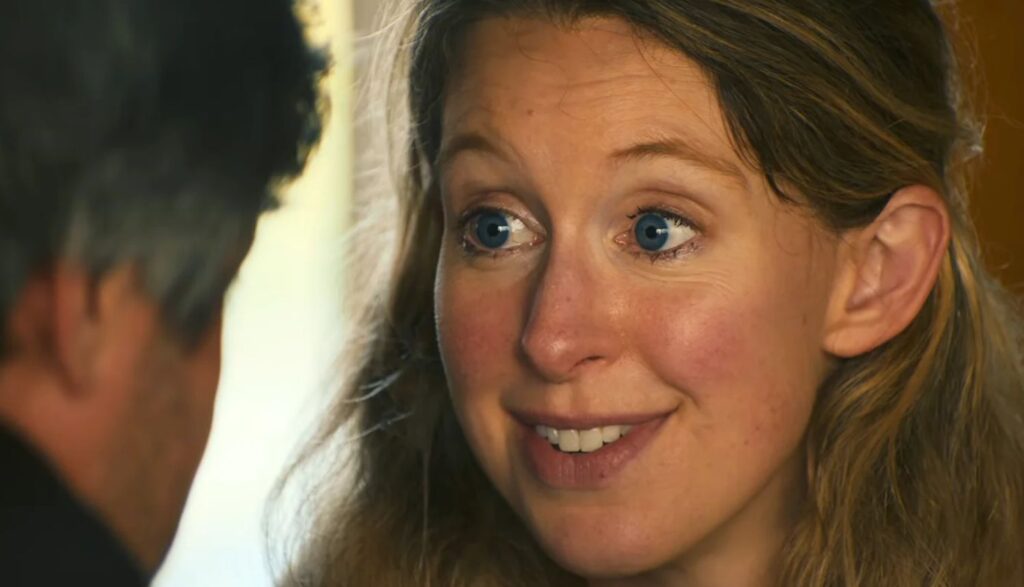
You Can See Everything starts as an Elizabeth Holmes documentary and becomes something far more fascinating. Strange, uncomfortable and impossible to look away from, this is documentary filmmaking at its best.
You Can See Everything Review: One of the Most Fascinating Documentaries Ever Made
There are documentaries that tell you a story. There are documentaries that uncover a story. And then there are documentaries like You Can See Everything, where you eventually realize the real story might be your own inability to figure out exactly what you're watching.
That is what makes this movie so good.
Nathan Fielder and Lance Oppenheim begin with what sounds like a relatively straightforward premise. Thirty-four days before disgraced Theranos founder Elizabeth Holmes is scheduled to report to prison, Holmes allows a film crew extraordinary access to her life. Fielder isn't just behind the camera. He becomes part of the story himself.
What follows is almost three hours of filmmaking that somehow becomes more fascinating the deeper it goes.
This isn't really a documentary about Theranos. It's not even necessarily a documentary about whether Elizabeth Holmes is telling the truth.
It's a movie about whether any of us can actually recognize the truth when we're watching it.
Elizabeth Holmes Is the Perfect Subject
Most people watching this already know the basic Elizabeth Holmes story.
She founded Theranos, became one of Silicon Valley's biggest stars, and claimed her company had developed revolutionary blood-testing technology. The company eventually collapsed, and Holmes was convicted on four fraud counts before receiving a prison sentence of more than 11 years.
But You Can See Everything isn't particularly interested in retelling that story.
That's its first brilliant decision.
There have already been documentaries, podcasts, books, news reports and a scripted television series about Theranos. Fielder and Oppenheim instead ask a much stranger question:
Who is Elizabeth Holmes when she knows we're watching her?
And even more importantly:
Can we ever actually know?
Holmes gives the filmmakers remarkable access to her home and family during her final weeks before prison. Her partner, Billy Evans, becomes an increasingly important part of the film as well.
The result can be incredibly uncomfortable.
Sometimes Holmes appears sympathetic.
Sometimes she appears completely calculated.
Sometimes she seems vulnerable.
Sometimes you wonder whether the vulnerability itself is another performance.
And the movie refuses to tell you which interpretation is correct.
That's where things become fascinating.
Nathan Fielder Is the Perfect Filmmaker for This
Putting Nathan Fielder across from Elizabeth Holmes almost feels like someone designed a filmmaking experiment specifically to test the limits of human manipulation.
Fielder has built his career around creating artificial situations and then observing how real people behave inside them. His deadpan style makes it difficult to determine exactly what he's thinking, even while you're watching him think.
Holmes presents almost the opposite problem.
She appears open. Emotional. Earnest. Personal.
But you're watching someone who was convicted of fraud.
So who do you trust?
The brilliance of the movie is that eventually you begin questioning Fielder too.
He starts the film as the skeptical observer. But the longer he spends around Holmes and Evans, the boundaries become increasingly complicated.
Is he documenting them?
Is he manipulating them?
Are they manipulating him?
Is he aware they're manipulating him?
Is he manipulating us by allowing us to believe he's being manipulated?
That sounds exhausting.
Watching it somehow isn't.
It's riveting.
The Movie Turns the Camera Back on the Audience
This is where You Can See Everything becomes much more than another true-crime documentary.
Most documentaries quietly establish a contract with the audience:
Trust us. We'll show you what happened.
Fielder and Oppenheim essentially destroy that contract.
Every documentary is edited. Every interview is framed. Every camera is positioned somewhere. Every filmmaker decides which footage you see and which footage disappears.
That means even a documentary claiming to reveal the truth is still presenting someone's version of it.
You Can See Everything makes that problem part of the movie itself.
At some point, you stop simply evaluating Holmes and start evaluating the filmmaking.
Why did they show me that?
Why did they cut from this moment to that one?
Was that interaction genuine?
Was somebody performing?
And then comes the most uncomfortable question:
Would I even know the difference?
That's why the title is so perfect.
You can see everything.
That doesn't mean you understand anything.
The Second Half Takes It Somewhere Completely Unexpected
This is also a movie where knowing less going in makes it significantly better.
The basic setup is enough.
Elizabeth Holmes is preparing to enter prison. Nathan Fielder is documenting her final weeks of freedom.
Go watch it.
Because what happens as the documentary progresses completely changes what kind of movie you're watching.
The structure itself becomes part of the experience. The film eventually expands beyond simply observing Holmes and starts interrogating how stories about real people are constructed, recreated and ultimately accepted as truth.
Amanda Seyfried, who played Holmes in The Dropout, even becomes part of that larger examination of where reality ends and representation begins.
I wouldn't want to explain much more than that.
The surprises matter.
But the transformation of the movie is one of the biggest reasons it works.
What begins as an Elizabeth Holmes documentary eventually becomes something closer to a psychological thriller, social experiment and examination of documentary filmmaking itself.
Nearly Three Hours Shouldn't Work
The runtime is 2 hours and 54 minutes.
That sounds ridiculous for a documentary about Elizabeth Holmes.
Yet unlike plenty of three-hour movies where you start checking the time, this one keeps finding another layer.
Normally I'd argue that almost any three-hour movie could lose 20 or 30 minutes.
Here, the length actually becomes part of the effect.
You need time with these people.
You need enough exposure to Holmes to start forming an opinion about her.
Then you need enough additional time to begin questioning that opinion.
The movie essentially allows you to experience the same uncertainty that Fielder appears to be experiencing.
That's difficult to accomplish in 90 minutes.
It's Also Surprisingly Funny
This could easily have become unbearably heavy.
Instead, Fielder's presence creates some genuinely funny moments.
They're rarely traditional jokes.
It's discomfort.
Awkward pauses.
Questions that nobody else would ask.
Interactions where you can't believe somebody actually said what they just said.
You'll laugh and then immediately wonder whether you should have laughed.
That uncomfortable humor is important because it keeps the movie from becoming another self-serious prestige documentary about fraud and wealthy people behaving badly.
It feels alive.
You genuinely don't know where the next conversation is going.
Why It Works So Well
The reason You Can See Everything is sitting at 98% with critics isn't simply because the Elizabeth Holmes story is interesting.
We've already heard that story.
This movie succeeds because it finds an entirely new way into it.
It's about Elizabeth Holmes, but it's also about charisma.
It's about manipulation.
It's about filmmaking.
It's about relationships.
It's about our obsession with turning complicated people into simple characters.
Hero.
Villain.
Victim.
Fraud.
And it's about something that feels increasingly relevant in 2026:
What happens when seeing something is no longer enough to prove that it's real?
We live in a world of edited clips, social media personas, documentaries, reenactments, influencers, artificial intelligence and competing versions of the same event.
We're surrounded by more visual evidence than any generation in history.
And somehow we're becoming less certain about what we're actually seeing.
You Can See Everything understands that problem better than almost any recent movie I've watched.
Final Take
You Can See Everything is one of those rare movies that gets better after it's over.
You leave the theater still processing it.
Then you start replaying conversations.
You reconsider moments you thought you understood.
You wonder who was manipulating whom.
And eventually you realize that might be the entire point.
Nathan Fielder and Lance Oppenheim could have made a very good documentary about Elizabeth Holmes.
Instead, they made something much more ambitious: a movie about our desire to believe that if we look closely enough, eventually we'll discover the truth.
Sometimes we don't.
Sometimes we just keep looking.
At 9.2/10, this is one of the best documentaries of the year and one of the most interesting movies of 2026, period.
Don't read too much about it before watching it.
Just watch it.
Then find someone else who has seen it, because you're probably going to want to talk about it.
Related Titles
Related Articles
Weekend Box Office Recap: Clayface Wins No. 1, but You Can See Everything Becomes a Documentary Phenomenon
Clayface wins the box office with $24M, but You Can See Everything jumps 25% to $19.5M. Wildwood opens softly, Street Fighter plunges 72%, and DC finds a promising new direction for its films.
Oct 26, 2026
Weekend Box Office Recap: Street Fighter Wins No. 1, but You Can See Everything Steals the Show
Street Fighter wins with $31M domestic, but Elizabeth Holmes documentary You Can See Everything steals the spotlight with a stunning $15M debut. Horror cools as the fall box office gains momentum again.
Nov 2, 2026
Weekend Box Office Recap: You Can See Everything Finally Takes No. 1 as Halloween Slows Theaters
You Can See Everything takes No. 1 with $10.6M, narrowly beating Clayface as Halloween slows theaters. Wildwood holds third, while Resident Evil crosses $400M worldwide.
Nov 2, 2026